
You hear about AI every single day. It’s in the news, your apps, and your workplace.
But here’s the frustrating part: most explanations are either too technical or too vague.
You want a real, clear answer, and this guide will give you just that.
By the end, you’ll understand the definition of AI, how it works, and how to learn artificial intelligence step by step.
Let’s dive in.
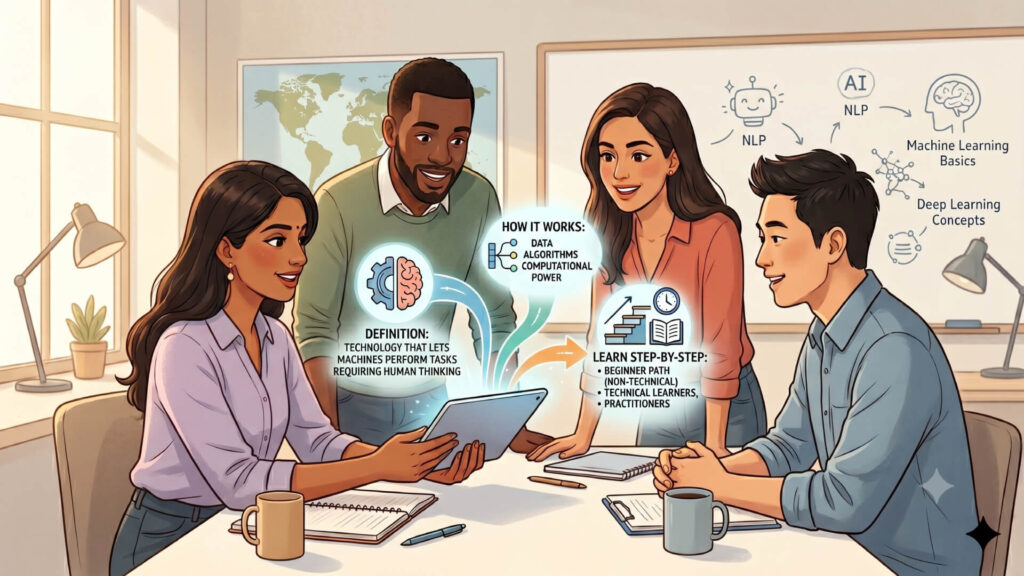
1. Definition of AI: What Exactly Is Artificial Intelligence?
Artificial intelligence (AI) is technology that lets machines perform tasks that normally require human thinking.
These tasks include learning from data, making decisions, solving problems, and understanding language.
Think of AI as a very smart calculator. Instead of only doing math, it can handle complex real-world decisions.
AI vs. Traditional Computer Programs
Traditional programs follow strict, pre-written rules. AI systems learn from experience and improve over time.
For example, a traditional program checks if a password matches. An AI system detects if a login looks suspicious.
Key Terms You Need to Know
• Machine Learning (ML): AI learns patterns from large amounts of data without being explicitly programmed.
• Deep Learning: A subset of ML that uses layered neural networks to process complex data like images and speech.
• Neural Networks: Computing systems loosely modeled after the human brain’s structure.
• Natural Language Processing (NLP): AI that understands and generates human language.
Fun Fact: IBM research shows 35% of companies already use AI in their operations.:
2. History of AI: From Science Fiction to Your Smartphone
The history of AI stretches back further than most people think.
In 1956, John McCarthy coined the term ‘Artificial Intelligence’ at Dartmouth College.
Major Milestones
• 1997: IBM’s Deep Blue defeats chess champion Garry Kasparov.
• 2011: IBM Watson wins Jeopardy, showcasing natural language processing.
• 2016: Google DeepMind’s AlphaGo defeats the world Go champion.
• 2022 to 2025: Generative AI models like ChatGPT and Gemini become mainstream tools.
Today, modern AI is evolving faster than ever. The shift from simple AI to AI agents, which are systems that can plan and act, is happening right now.
3. AI Applications: Where AI Lives in Your Daily Life
AI applications are everywhere. You probably use several every single day.
Everyday Life
• Smart assistants: Siri, Alexa, and Google Assistant answer your questions instantly.
• Recommendation systems: Netflix and Spotify predict what you want to watch or hear next.
• Spam filters: Your email inbox stays clean because AI catches junk automatically.
Business & Industry
• Finance: AI detects fraud, automates trading, and personalizes banking.
• Healthcare: AI reads X-rays, speeds up drug discovery, and analyzes genomes.
• Transportation: Self-driving cars and AI traffic management save time and lives.
Innovative Cases
AI now helps scientists compress years of research into weeks.
In drug development, AI models can screen millions of compounds in hours instead of decades.
4. Core Technologies of AI: The Engine Under the Hood
Understanding AI means knowing its three core pillars.
• Data: The raw material AI learns from. More quality data equals better AI.
• Algorithms: The recipes AI follows to find patterns and make decisions.
• Computational Power: The processing muscle (GPUs, cloud servers) that runs it all.
Basics of Machine Learning and Deep Learning
Machine learning basics start with feeding labeled data into a model. The model learns to spot patterns.
Deep learning concepts go further by using layers of artificial neurons to handle images, audio, and text.
Natural Language Processing (NLP)
NLP lets machines read, write, and understand human language.
ChatGPT and similar tools run on powerful NLP models called Large Language Models (LLMs).
Computer Vision and Image Recognition
Computer vision enables AI to ‘see.’ It powers facial recognition, medical imaging, and self-driving cars.
5. AI’s Impact on Daily Life: The Good, the Tricky, and the Future
Convenience and Efficiency
AI tools save you hours every week. They automate repetitive tasks and surface smarter insights faster.
AI helps businesses reduce costs and serves customers 24/7 without a coffee break.
Ethical and Privacy Concerns
More AI means more data collection. That raises important privacy questions.
AI bias, which happens when models produce unfair outcomes, remains a serious challenge.
Transparency about how AI makes decisions is essential and still improving.
AI Impact on Daily Life: Jobs and Future Trends
The World Economic Forum estimates AI will displace some jobs but create many new roles.
Skills such as prompt engineering, data analysis, and AI literacy are becoming increasingly valuable.
6. How to Learn AI: Your Practical Roadmap
Here’s the honest truth: you don’t need a PhD to learn AI. You need the right path.
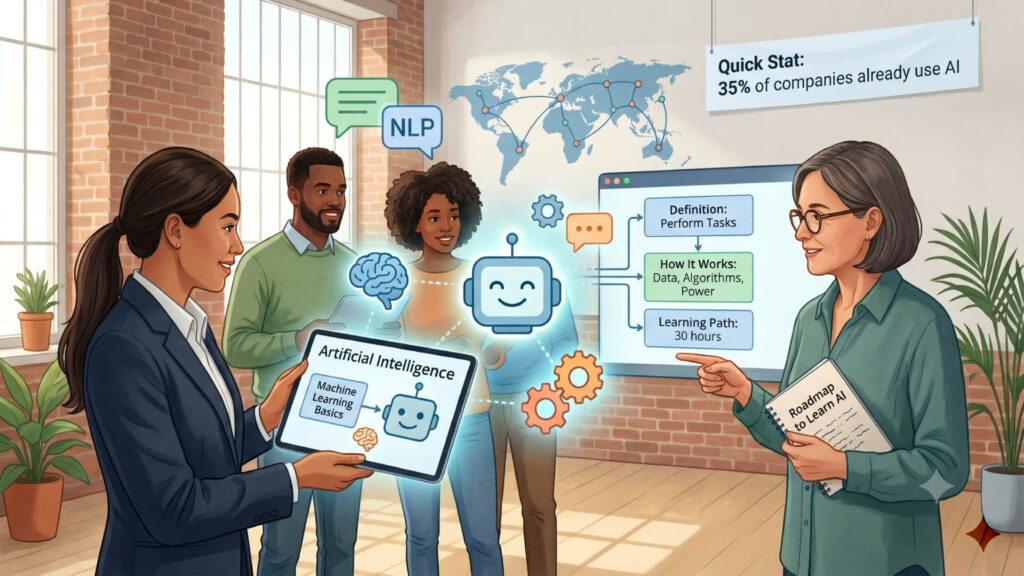
Quick Stat’, ‘The World Economic Forum says basic AI skills take about 30 hours to learn. A structured course takes 3–4 months.:
Recommended Learning Paths
• Beginners (non-technical): Start with Andrew Ng’s ‘AI for Everyone’ on Coursera. Zero coding required.
• Technical learners: Learn Python first. Then explore TensorFlow or PyTorch for ML frameworks.
• Practitioners: Use DataCamp for hands-on projects integrating Python with AI tools.
Recommended Beginner-Friendly Tools and Platforms
• Coursera – Structured, university-backed courses from Stanford and DeepLearning.AI.
• DataCamp – Hands-on, code-first AI learning environment.
• Google Cloud Learn – Free resources covering generative AI and AI agents.
• ChatGPT/Claude – Start experimenting immediately. Prompt engineering is a skill in itself.
Tips to Learn Faster
• Build small projects early. Doing beats just reading.
• Follow AI newsletters (e.g., The Batch by DeepLearning.AI).
• Join communities on Reddit (r/MachineLearning) or Discord AI groups.
Conclusion: The Best Time to Start Is Now
AI trends are accelerating. Waiting means falling further behind.
You now understand the definition of AI, its history, its applications, and how to start learning.
AI isn’t just for engineers and researchers. It’s for marketers, doctors, teachers, entrepreneurs, and everyone else.
Pick one resource from Section 6 today. Take your first 30-minute lesson. That’s all it takes to begin.
The future belongs to people who understand and use AI effectively. That can be you.
Frequently Asked Questions (FAQ)
Q: What is AI in simple terms?
A: AI is technology that lets machines learn from data, solve problems, and make decisions. These are tasks that usually need human intelligence.
Q: What is the difference between AI, machine learning, and deep learning?
A: AI is the big umbrella. Machine learning is a type of AI that learns from data. Deep learning is a more advanced form of machine learning that uses layered neural networks.
Q: Do I need to know how to code to learn AI?
A: Not necessarily. Courses like ‘AI for Everyone’ on Coursera require zero coding. But learning Python will open up far more opportunities.
Q: How long does it take to learn AI?
A: Basic AI skills take about 30 hours. A solid foundational course takes 3–4 months. Advanced expertise takes 1–2 years of focused study.
Q: What are the most common AI applications today?
A: The most common AI applications include smart assistants (Siri, Alexa), recommendation systems (Netflix, Spotify), fraud detection, medical imaging, and language models like ChatGPT.
Q: Is AI dangerous?
A: Current AI (narrow AI) is not dangerous in a sci-fi sense. The real risks today are bias, privacy violations, and job displacement. All of these can be managed with good policy and education.
Q: What are the best free resources to learn AI?
A: Google’s ‘Introduction to Generative AI’ on Google Cloud, Andrew Ng’s free courses on Coursera, fast.ai for practical deep learning, and YouTube channels like 3Blue1Brown are all excellent starting points.